Oh, What A Lovely Bond
Tuesday Comic Strip Day.
Hogan's Alley is one of the most fascinating newspaper strip magazines around. Even though it is only published once a year, it is always a treasure trove of good stuff, worth many hours of reading.
In May last year, editor Tom Heintjes put this interesting article by Jay Maeder on the Hogan's Alley blog.
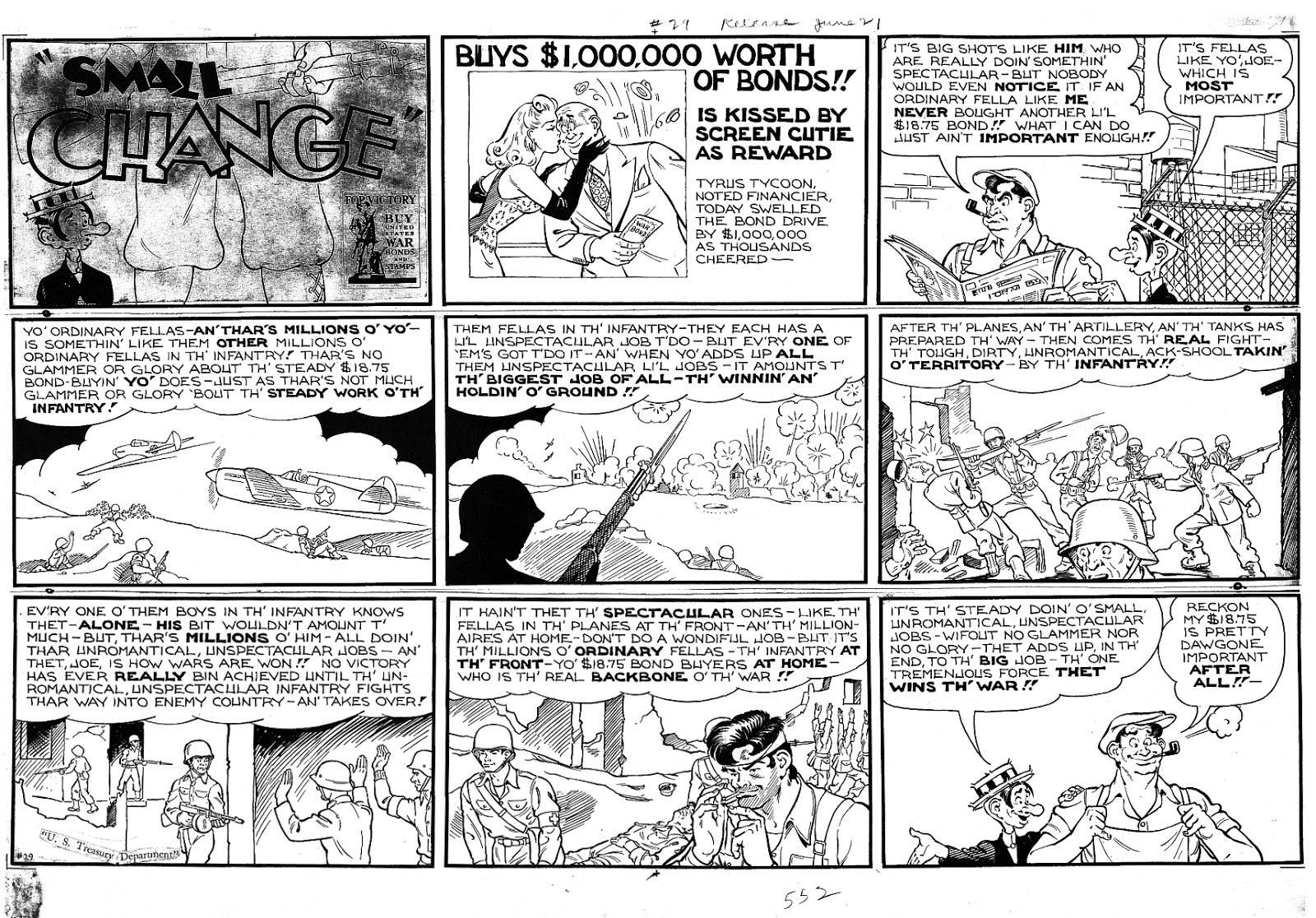
It is about a longrunning, but almos forgotten strip by Al Capp. Although it ran for more than four years, I have never seen many samples. Here is the whole article, followed by the samples Tom gives (from Denis Kitchen's collection), along with a couple of originals I found online and one (count them, one) original scan by me.
Unable to serve in the military, Al Capp spearheaded cartoonists’ effort to raise money to fight in World War II.
Early in 1942, when his Li’l Abner was not yet eight years old but was already a monument in American life and letters, faithfully followed in every hamlet and valley of the nation, Al Capp came to the decision that he would neither put Abner Yokum into military uniform nor permit the horrors of war to intrude into peaceful, happy, unfretful, undarkened Dogpatch. His public rationale, stated in a letter-to-the-reader strip that July 4: “Perhaps

this small section of our daily newspaper can do its part best by helping us to remember that a free world once did exist-and will again!!” Still, in 1942, a good citizen wanted to contribute something material to the war effort. And perhaps it is ungenerous to posit that Capp might have been smarting at the public attentions showered upon his hated onetime employer Ham Fisher, creator of the equally popular
Joe Palooka, who had signed Joe up in the Army more than a year earlier, thus sparking such a wave of enlistments that President Franklin Roosevelt himself had hailed both Fisher and Joe as the greatest of patriots.
To Washington went 32-year-old Capp. There he presented himself to the United States Treasury Department and offered his professional services as a highly visible homefront propagandist.
What resulted from those meetings was Capp’s third strip, after
Li’l Abner and
Abbie an’ Slats, a public-service feature titled
Small Fry—and, beyond that, a goodwill relationship between Treasury and the band of comics men who would subsequently become the National Cartoonists Society.
The U.S. government had been selling investment in itself to private citizens since 1789. In 1942, millions well remembered that the famous federal securities called Liberty Bonds had funded much of the Yank participation in the European War in 1917 and 1918. Now, this bleak generation later, Treasury was offering the new Series E issue and entreating patriotic Americans, via a massive promotional campaign in the public prints, to put aside 10 percent of their weekly paychecks for these star-spangled bonds that would surely buy defeat for Tojo and Hitler. Now, at about the same time he was concocting his first Fearless Fosdick yarn over in Li’l Abner, it became Al Capp’s job to help Treasury sell its urgent message.
Though Capp neither bylined nor signed
Small Fry—indeed, not unlike
Li’l Abner itself, most of it was doubtless produced by his longtime Boston-studio assistants, Al Amato and Harvey Curtis and Walter Johnston—the feature looked and sounded exactly like
Abner, and there was no comics reader in the firmament who could not possibly have recognized that the Capp shop was plainly behind the thing. Made available to newspapers free of charge by Treasury—Capp himself took just a public-spirited dollar a year for the strip’s production—
Small Fry premiered amid much fanfare on Sunday, May 31, 1942, introducing a solemn little runt who was much too small a fry to get into the Army or the Navy or the Marine Corps or even to land a defense-plant job and who accordingly settled for helping to win the war by buying as many of Treasury’s war bonds as he could afford and shaming his tightwad neighbors into doing the same.
And here was the strip’s sole mission. This was every American’s world war, and every hometown civilian was expected to dig deep and sacrifice to finance the enterprise every bit as much as our valiant boys overseas could be counted upon to fight to their brave deaths. “Taxes alone cain’t do it!” whispered
Small Fry’s voluptuous lady friend Tallulah as her determined little fella earnestly chased down one deranged scheme after another in his never-ending quest for a few more bucks that could buy him still more war bonds. Series E securities were $18.75 apiece and they were guaranteed to repay their bearers $25 after ten years. “It’s the world’s biggest double-barreled BARGAIN!” whooped Small Fry. Meanwhile, eighteen dollars and seventy five cents bought nearly a thousand bullets. A hundred bought a bomb. Fifty thousand built an airplane.
By the time the
Small Change feature disappeared from the nation’s Sunday funnies in 1945, Capp had undertaken additional services for which his government was grateful. Abner Yokum ended up in uniform after all, if only in specially drawn posters and pamphlets supplied exclusively to military installations. Somehow the war was won despite Abner’s participation. Terry Lee and Don Winslow and Johnny Hazard and Buz Sawyer, not to mention Joe Palooka and Jerry Leemy, had done most of the heavy lifting anyway.

Since Pearl Harbor, a loosely knit unit of several dozen stripmen, more or less presided over by Gus Edson and C.D. Russell, had indefatigably staged hundreds of morale-boosting shows at Army camps and Navy bases and veterans’ hospitals; Al Capp’s particular specialty was visiting the amputee wards, displaying his own wooden leg that he’d worn since childhood and brusquely ordering the gloomily damaged young men to stop feeling so goddam sorry for themselves. After the war, several of the more prominent of them—Edson, Russell, Rube Goldberg, Russell Patterson, Otto Soglow, Milton Caniff, Ernie Bushmiller, a few others—agreed among themselves that they would continue their pro bono good works. This was one of the reasons they formally organized themselves into the National Cartoonists Society in New York in March 1946.
From the beginning, Milt Caniff and Al Capp—fast friends since their scuffling Associated Press days in the early 1930s, boundless admirers of each other’s work, by now both masters of self-promotion, the two daily newspaper cartoonists who routinely arranged for themselves more glowing personal publicity in the national magazines than any other ink-stained wretch could ever dream of—were the runaway chieftains of the new NCS. Between them they won the first two annual Cartoonist of the Year awards, then named in honor of the immortal Billy DeBeck. Caniff was quickly NCS president; Capp, who himself never sought office, was always quietly at his side. Together they consulted and set the Society agenda for years to come, subsequently aided and abetted by such like-minded colleagues as Alex Raymond and Walt Kelly. Here was the NCS political bloc against which poor crazed Ham Fisher never had a chance as he embarked upon his famously protracted campaign to discredit and disgrace Al Capp.

But that’s another story. Here is this one—as, in early 1949, with Red China on the march and Soviet spies filching atomic secrets, the United States Treasury Department set out once again to drive home to every citizen the obligation to buy up civilization-preserving savings bonds—and it called upon the National Cartoonists Society.
If the NCS was largely a marching-and-chowder fraternity of good fellows well met, quite devoted to good food and drink and the occasional ribaldry, it also very much remained a public-service organization. The cartoonists still regularly entertained hospitalized veterans with chalk talks, and they generously donated their time and talents to the Boy Scouts and the March of Dimes and the Heart Fund and the Cancer Fund and the Anti-Tuberculosis Drive and the Crippled Children’s Committee, and they sent poor New York kids to summer camp. When Treasury asked for major funny-papers participation in the ambitious 1949 bond drive—“Be A ’49er,” the campaign was called, its symbol the cross-country covered wagon of pioneer days—President Caniff was most pleased to call on his members for such.

Treasury officials were introduced to the cartoonists in New York in late January, at a banquet notably enlivened by Ham Fisher, who screamed curses at Al Capp throughout Treasury’s presentation of awards and citations, somewhat to public notice. In mid-February, Caniff and Capp went to Washington to meet with Treasury Secretary John Snyder and his press attache Jacob Mogelever and hammer out the details. The official drive dates were May 16 through June 30, which gave the newspaper stripmen just enough lead time to work one bond-sales mention or another into their features. Comic books, represented at NCS by longtime Famous Funnies editor Steve Douglas, were more difficult: Treasury had not understood comic-book production timetables and most publishers could not comply with Washington’s request for special covers and features in their May and June and July issues. But the newspapermen had their 12 weeks to figure something out.

And so, through May and June, dozens of daily and Sunday newspaper comics concertedly sold Savings Bonds, to one degree or another. Some fellows merely stuck a buy-a-bond bug into the handiest available white space and let it go at that. Some just drew buy-a-bond billboards or some such into their street-scene backgrounds. Others did more ambitious special strips, interrupting their storylines with Treasury pep talks. Johnny Hazard lectured solemnly: “Right now Uncle Sam is giving us an opportunity to tend to our futures!” Kerry Drake went on television to address the public: “Be a modern ’49er! Join the only gold rush where everyone strikes it rich!” Nice old busybody Mary Worth became a door-to-door bond saleslady for a full week: “I’m Mrs. Worth from around the corner…and I’d like to talk to you about U.S. savings bonds!”
And the ever-vainglorious Ham Fisher, never reluctant to inform his readers how much his nation valued him, put Humprey Penneyworth into Treasury Secretary Snyder’s private office. “May we break off our story for a moment to convey a vitally important message,” Fisher gravely announced in an interruption of the Joe Palooka daily of Monday, May 16. “Once again our gov’t calls on the Joe Palooka strip to fire the opening gun.” And here was Humphrey, cap in hand: “Mister Secretary of the Treas’ry Snyder, I got yore message an’ I’m ready t’start out sellin’ them there U.S. Savings Bonds. I’m shore hepped up. An’ thank ya fur this great honor.” Warmly replied Snyder: “That’s great, Humphrey. This is every American’s opportunity to be a modern 49er by buying U.S. Savings Bonds. It’s vitally necessary to build an economically stronger America.”
If Fisher had imagined, at the time he produced that strip, that he really was firing the first shot, he must have been crushed on April 17, when Al Capp showed up in the Sunday papers a full month ahead of everyone else—with a
Li’l Abner Treasury special that featured not only Secretary Snyder but President Harry Truman as well.
Plainly turned around by Capp instantly upon his return from Washington, the page broke into the Washable Jones-and-the-Shmoos sequence with the delivery of an official government letter to Pansy Yokum in Dogpatch:
“Dear Mammy Yokum: You have been selected by the Treasury to inform your community—and all the communities of the United States—of the new Savings Bond drive, starting May 16.
“Next Tuesday, April 19, anniversary of the battles for American freedom at Lexington and Concord, President Truman will pay special honor to the county and city chairmen of local Savings Bond volunteer committees.
“Security is the essence of American freedom. I want you to let Americans know that Savings Bonds are a safe, sure, profitable investment in security and freedom.
“Sincerely,
“John W. Snyder
“Secretary of the Treasury”
And there were Mammy and Pappy, in Washington, with Snyder and Truman in the Oval Office. “Just tell folks this,” the genial President of the United States said to them. “Every American’s opportunity in 1949 is U.S. Savings Bonds!! Tell ’em—Be a 1949 Forty-Niner!! Buy bonds regularly!!”
They shore would. Back home in Dogpatch, Pansy gathered all the hillfolk around her and declaimed: “On April 19th, 1775, our ancestors fit for thar security an’ freedom wif GUNS!! On April 19th, 1949, we Americans kin PRESARVE thet security an’ freedom wif our SAVIN’S!! Namely, by BUYIN’ U.S. SAVINGS BONDS!!”
Capp’s April 17 page was the showpiece of the entire NCS campaign; Treasury reprinted it into posters and handbills and distributed it widely. Again, it is fair to surmise that Capp and Pansy Yokum must have sold a few bonds. Again, it can’t be known how many. But performance was apparently impressive enough that Treasury co-sponsored the NCS traveling art exhibit for the rest of the year, flying it around the nation in a chartered airliner. In October, that exhibit hit the Library of Congress and the cartoonists formally met Truman in the Rose Garden and they all sketched portraits of him. “Biggest thing that has happened to any cartoonist since George McManus was made a Kentucky Colonel,” dryly noted Gus Edson in the NCS newsletter.
From the collection of Denis Kitchen:
Later on the strip was recalled Small Change and a numbering was added.
My own scan is #21. The originals after that are numbered as well. The first few are from the collection at the University of Michicab, then there are a few from CoollinesArt (which apparently are still for sale) and some that were already sold by Heritage Auctions. If you woner, the going price for these is $400/500.